This website stores cookies on your computer. These cookies are used to collect information about how you interact with our website and allow us to remember you.
We use this information in order to improve and customize your browsing experience and for analytics and metrics about our visitors both on this website and other media.
To find out more about the cookies we use, see our Privacy Policy.
Accreditation and CLE Rules for Georgia
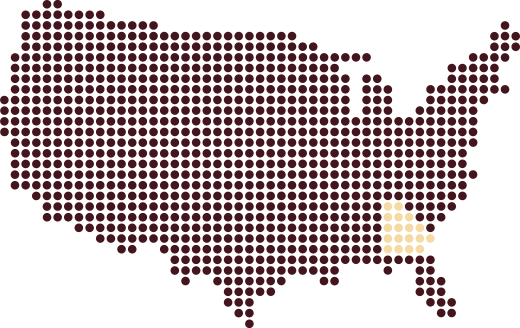
Courses purchased through UnitedCLE.com are provided and fully accredited by The National Academy of Continuing Legal Education, a provider of CLE courses in Georgia approved by the Georgia Commission on Continuing Lawyer Competency, sponsor #3730.
Georgia attorneys are required to take 18 credit hours every 2 years, including 3 credit hours of Ethics and 2 credit hours of Professionalism.
Georgia attorneys can earn all 18 CLE credit hours with us including 3 credit hours of Ethics and 2 credit hours of Professionalism using our Online & iOS/Android App courses.
Georgia attorneys must complete their continuing legal education requirements by December 31st every 2 years. Georgia attorneys must return their annual report to the Commission by February 15th.
Georgia attorneys are permitted to carryover a maximum of 18 general credits, including 3 ethics credits, 2 professionalism credits to the next reporting period.
*Effective January 1, 2026, the State Bar of Georgia will require active members to complete 18 hours of continuing legal education (CLE) every two years, increasing from the current 12 hours annually. Within these 18 hours, members—except those in the Georgia Transition Into Law Practice Program—must complete at least 3 hours in legal ethics and 2 hours in professionalism, with unused ethics and professionalism credits carryable up to the next biennial period but not beyond. Members may also carry over up to 18 unused CLE hours to the following period.
CLE activities should relate to the member’s practice area or benefit their practice and clients. These changes shift CLE reporting to a biennial cycle with increased total requirements and specific minimums for ethics and professionalism. This new rule also eliminates the specific trial credits course requirement for Georgia trial attorneys. The CLE compliance deadline will be December 31st of every odd year. The first biennial compliance period begins January 1, 2026, and ends December 31, 2027.
GA Commission on Continuing Lawyer Competency
104 Marietta St. NW, Suite 100
Atlanta, GA 30303
(t) 800-334-6865
(f) 404-527-8717 www.gabar.org
Courses purchased through UnitedCLE.com are provided and fully accredited by The National Academy of Continuing Legal Education, a provider of CLE courses in Georgia approved by the Georgia Commission on Continuing Lawyer Competency, sponsor #3730.
To view our full accreditation details please .
General Credits
1
$29
All Courses Available iOS/Android Web
About This Course
An alphabet soup made up of RMBS, CMBS, CDOs, SIVs have been in the press for the last few years and while they perform an integral part of the capital markets, few know what they are. Some commentators and regulators have alleged that these sophisticated financial instruments were responsible for the Credit Crisis that nearly destroyed the global economy. What are these structured products, how do they work and who created them?
New York attorney and subject matter expert Jack Chen explains the essential characteristics of structured finance and then provides a survey of the different types of asset backed securities in the market. The course explains the roles of originators, servicers, trustees, managers and rating agencies while reviewing sample capital stacks and cash flows for each type of transaction and surveys the areas of laws that any practitioner needs to know in working in this area.