


This website stores cookies on your computer. These cookies are used to collect information about how you interact with our website and allow us to remember you.
We use this information in order to improve and customize your browsing experience and for analytics and metrics about our visitors both on this website and other media.
To find out more about the cookies we use, see our Privacy Policy.
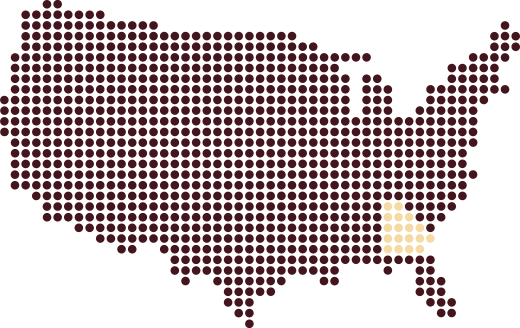
Accreditation and CLE Rules for Georgia
Courses purchased through UnitedCLE.com are provided and fully accredited by The National Academy of Continuing Legal Education, a provider of CLE courses in Georgia approved by the Georgia Commission on Continuing Lawyer Competency, sponsor #3730.
*Notice from GA Board on Continuing Legal Education: The Supreme Court of Georgia has permanently suspended the rule limiting the number of distance learning courses GA attorneys are allowed to take. Attorneys may now take All 12 CLE Credits with our Online & iOS/Android App courses. GA Supreme Court Notice
Georgia attorneys are required to take 12 credit hours every year including 1 credit hour of Ethics and 1 credit hour of Professionalism.
Georgia attorneys can earn all 12 CLE credit hours with us including 1 credit hour of Ethics and 1 credit hour of Professionalism using our Online & iOS/Android App courses.
Georgia attorneys must complete their continuing legal education requirements by December 31st every year. Georgia attorneys must return their annual report to the Commission by March 31st each year.
Georgia attorneys are permitted to carryover a maximum of 12 credits, including 2 ethics credits, 2 professionalism credits, and 3 trial credits, to the next reporting period.
*Effective January 1, 2026, the State Bar of Georgia will require active members to complete 18 hours of continuing legal education (CLE) every two years, increasing from the current 12 hours annually. Within these 18 hours, members—except those in the Georgia Transition Into Law Practice Program—must complete at least 3 hours in legal ethics and 2 hours in professionalism, with unused ethics and professionalism credits carryable up to the next biennial period but not beyond. Members may also carry over up to 18 unused general CLE hours to the following period.
CLE activities should relate to the member’s practice area or benefit their practice and clients. These changes shift CLE reporting to a biennial cycle with increased total requirements and specific minimums for ethics and professionalism. This new rule also eliminates the specific trial credits course requirement for Georgia trial attorneys. The CLE compliance deadline will be December 31st of every odd year. The first biennial compliance period begins January 1, 2026, and ends December 31, 2027.
There are no changes for the 2025 CLE requirement. The 2025 CLE deadline remains December 31, 2025.
GA Commission on Continuing Lawyer Competency
104 Marietta St. NW, Suite 100
Atlanta, GA 30303
(t) 800-334-6865
(f) 404-527-8717 www.gabar.org
The Rise of Cannabis Personal Injury Litigation: Emerging Claims, Law, Science and Trial Strategies
Courses purchased through UnitedCLE.com are provided and fully accredited by The National Academy of Continuing Legal Education, a provider of CLE courses in Georgia approved by the Georgia Commission on Continuing Lawyer Competency, sponsor #3730.
To view our full accreditation details please .
General Credits
1
$29
All Courses Available iOS/Android Web
About This Course
This CLE program explores the rapidly developing field of cannabis-related product liability and personal injury litigation. As the commercial THC market expands nationwide, courts are beginning to confront claims involving addiction, psychiatric injury, cognitive impairment, and other alleged harms associated with high-potency cannabis products.
The course examines the evidentiary and legal theories shaping this emerging docket, including failure to warn, design defect, negligent marketing, consumer protection violations, and public nuisance claims. Participants will analyze how plaintiffs are framing allegations concerning industry knowledge of risk, product potency, and marketing practices, as well as the defenses likely to be asserted by manufacturers, distributors, and retailers.
In addition to substantive law, the program addresses practical litigation considerations—causation challenges, expert development, regulatory overlay, federal-state tensions, and damages modeling. Attendees will gain a working understanding of the strategic, scientific, and procedural issues that define cannabis-related injury cases and will leave equipped to evaluate and litigate claims arising from THC products.