This website stores cookies on your computer. These cookies are used to collect information about how you interact with our website and allow us to remember you.
We use this information in order to improve and customize your browsing experience and for analytics and metrics about our visitors both on this website and other media.
To find out more about the cookies we use, see our Privacy Policy.
Accreditation and CLE Rules for New Jersey
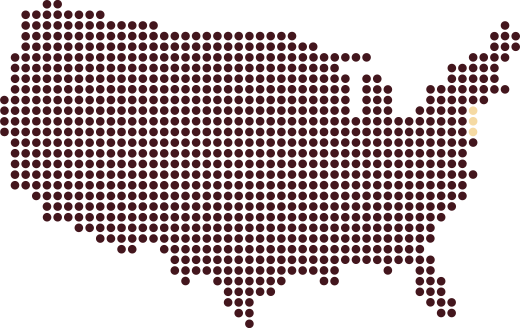
Courses purchased through UnitedCLE.com are provided and fully accredited by The National Academy of Continuing Legal Education, a New Jersey Accredited CLE Provider.
New Jersey attorneys are required to take 24 credit hours every 2 years including 5 credit hours of Ethics and Professionalism, with a minimum of 2 credits of Diversity, Inclusion, and Elimination of Bias.
New Jersey attorneys can earn all 24 CLE credit hours with us including 5 credit hours of Ethics and Professionalism with a minimum of 2 credit hours of Diversity, Inclusion, and Elimination of Bias using our Online, iOS/Android App, and Live Webinar courses.
*CLE Rule Update: The New Jersey CLE Board has revoked the Covid exception and reinstated the Live CLE requirement in NJ effective 1/1/2024. Additionally, NJ has amended the CLE Regulations with BCLE Reg. 103:1(n) and expanded the definition of Live Instruction. Our Live Interactive webinars meet this definition of Live CLE in NJ. Therefore all NJ attorneys can satisfy their entire requirement with our Online, iOS/Android App, and Live Webinar courses.
*CLE Rule Update: The New Jersey Supreme Court has amended Court Rule 1:42-1 to require attorneys to complete at least one CLE credit in technology-related subjects during each two-year reporting cycle.
This requirement takes effect January 1, 2027 and will first apply to attorneys whose reporting cycle ends December 31, 2027 (reported in 2028), and all cycles thereafter. Attorneys in the current reporting cycle ending December 31, 2026 are not subject to this requirement.
Live Exemption: NJ rule 201:8(a) states that attorneys who reside in, work in, and are licensed in a mandatory CLE jurisdiction that does not require Live CLE are also exempt from Live CLE for NJ. These attorneys can take all 24 credits of their requirement with on-demand courses.
See our NJ Non-Resident Bundles.
Each active New Jersey attorney is permanently assigned to one of two compliance groups for CLE purposes.
Group 1 is attorneys with birthdays in January through June and must complete their CLE by 12/31 every odd numbered year (12/31/2025, 12/31/2027, etc…)
Group 2 is attorneys with birthdays in July through December and must complete their CLE by 12/31 every even numbered year (12/31/2024, 12/31/2026, etc…)
Newly Admitted Attorneys in New Jersey must complete 24 credits of approved CLE in their first full two-year compliance period. Of the 24 credits at least 5 credits must be in Ethics/Professionalism, of which at least 2 must be in Diversity, Inclusion, and Elimination of Bias.
Additionally, 16 credits must be in any 6 of the following 12 subject areas:
New Jersey Basic Estate Administration,
New Jersey Basic Estate Planning,
New Jersey Civil or Criminal Trial Preparation,
New Jersey Family Law Practice,
New Jersey Real Estate Closing Procedures,
New Jersey Trust and Business Accounting,
New Jersey Landlord/Tenant Practice,
New Jersey Municipal Court Practice,
New Jersey Administrative Law,
New Jersey Labor and Employment Law,
New Jersey Worker's Compensation Law,
and New Jersey Law Office Management.
A minimum of one credit must be taken in New Jersey attorney trust & business accounting fundamentals. NJ Newly Admitted Attorneys can satisfy all of their credit hours with us using our Online, iOS/Android App, and Live Webinar courses.
Supreme Court of New Jersey Board on Continuing Legal Education
PO Box 965
Trenton, NJ 08625-0965
Phone: (609) 815-2930 https://www.njcourts.gov/attorneys/cle
The Rise of Cannabis Personal Injury Litigation: Emerging Claims, Law, Science and Trial Strategies
Courses purchased through UnitedCLE.com are provided and fully accredited by The National Academy of Continuing Legal Education, a New Jersey Accredited CLE Provider.
To view our full accreditation details please .
General Credits
1.1
$29
All Courses Available iOS/Android Web
About This Course
This CLE program explores the rapidly developing field of cannabis-related product liability and personal injury litigation. As the commercial THC market expands nationwide, courts are beginning to confront claims involving addiction, psychiatric injury, cognitive impairment, and other alleged harms associated with high-potency cannabis products.
The course examines the evidentiary and legal theories shaping this emerging docket, including failure to warn, design defect, negligent marketing, consumer protection violations, and public nuisance claims. Participants will analyze how plaintiffs are framing allegations concerning industry knowledge of risk, product potency, and marketing practices, as well as the defenses likely to be asserted by manufacturers, distributors, and retailers.
In addition to substantive law, the program addresses practical litigation considerations—causation challenges, expert development, regulatory overlay, federal-state tensions, and damages modeling. Attendees will gain a working understanding of the strategic, scientific, and procedural issues that define cannabis-related injury cases and will leave equipped to evaluate and litigate claims arising from THC products.