This website stores cookies on your computer. These cookies are used to collect information about how you interact with our website and allow us to remember you.
We use this information in order to improve and customize your browsing experience and for analytics and metrics about our visitors both on this website and other media.
To find out more about the cookies we use, see our Privacy Policy.
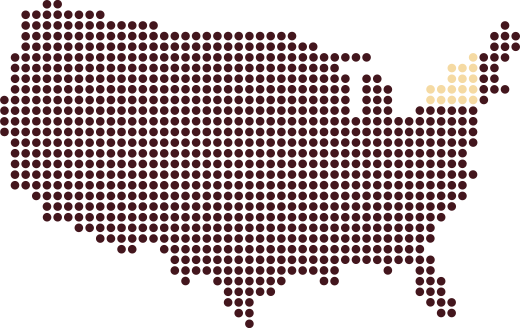
Accreditation and CLE Rules for New York
Courses purchased through UnitedCLE.com are provided and fully accredited by The National Academy of Continuing Legal Education, an Accredited NYS CLE Provider.
The NY CLE Board maintains an Accredited Provider directory on their website. You can find National Academy of Continuing
Legal Education listed on the most recent directory at https://webfiles.nycourts.gov/public/2026-07/06.15.26.ap-list_0.pdf.
Experienced NY are required to take 24 credit hours every 2 years including 4 credit hours of Ethics and 1 credit hour of Diversity, Inclusion and Elimination of Bias and 1 credit of Cybersecurity, Privacy and Data Protection.
NY attorneys can earn all 24 CLE credit hours with us using our Online & iOS/Android App courses.
*Beginning on July 1, 2023, experienced attorneys are now required to take at least 1 CLE credit in the category of Cybersecurity, Privacy and Data Protection in each compliance period. This new requirement applies to all attorneys due to re-register on or after July 1, 2023 (birthday is on or after July 1st). Please note that this does not change the total amount of credits required in your CLE period, the total requirement remains at 24 credits.
Experienced NY attorneys are required to complete their requirement every 2 years by their birthday with a 30 day automatic grace period. Attorneys admitted to practice in even years are due on even years and attorneys admitted in odd years are due in odd years.
New York attorneys must report that they are CLE compliant on their biennial registration form and must retain proof of compliance for a minimum of four years. National Academy of CLE issues a NY CLE Certificate of Attendance for all CLE activities as proof of compliance and we store the certificate in your CLE Account indefinitely.
Newly admitted attorneys must complete 16 CLE credits each year for the first two years following admission to the Bar. These are "transitional" courses and must include 3 Ethics, 6 Skills, and 7 Law Practice Management (LPM) or Professional Practice (PP) credits. Additionally, 1 credit of Cybersecurity, Privacy and Data Protection must be completed in either of the first two years.
Newly admitted attorneys must complete their CLE in the following formats:
Law Practice Management, Areas of Professional Practice, and Cybersecurity, Privacy and Data Protection-General:
any approved format, including non-participatory formats such as on-demand audio or video and live broadcast.
Ethics and Professionalism and Cybersecurity, Privacy and Data Protection-Ethics:
traditional live classroom, fully interactive videoconference, or simultaneous transmission with synchronous interactivity, such as web conference or teleconference, where questions are permitted during the program.
Skills:
traditional live classroom or fully interactive videoconference attended in a group setting only (Effective January 1, 2026).
Newly admitted attorneys based in law offices outside of the United States may complete up to 16 credits in any approved format. Any remaining credits must be completed in a format permitted for the applicable credit category.
Newly admitted attorneys with a prorated CLE requirement must complete their credits in a format permitted for the applicable credit category, except that no more than 14 credits may be earned through non-participatory formats, such as on-demand audio or video or live broadcast. For more information about Bridge The Gap CLE formats, click here.
Newly admitted attorneys can complete all 16 required credit hours with us through a combination of our on-demand Professional Practice (PP), Law Practice Management (LPM), and Cybersecurity courses, along with our live Skills and Ethics programs. You can see our options for Bridge the Gap CLE here: Bridge the Gap CLE Options.
Courses purchased through UnitedCLE.com are provided and fully accredited by The National Academy of Continuing Legal Education, an Accredited NYS CLE Provider.
To view our full accreditation details please .
Professional Practice
1
$29
All Courses Available iOS/Android Web
About This Course
This CLE program examines the emergence of Artificial Swarm Intelligence (ASI) and its potential impact on the practice of law. Moving beyond traditional AI tools, ASI relies on networks of coordinated AI agents that can collaborate, adapt, and perform complex tasks across legal workflows, including research, compliance, contract management, litigation analysis, and strategic decision-making.
As legal work increasingly incorporates interconnected AI systems, questions arise regarding supervision, accountability, and liability when outcomes are generated through the actions of multiple agents rather than a single actor. The course will explore how existing legal doctrines may apply to these technologies and introduce concepts such as distributed liability and algorithmic accountability as frameworks for assessing responsibility in AI-driven environments.
Participants will also examine evolving models of legal practice that integrate advanced AI systems, along with the regulatory, ethical, and governance challenges these technologies present. The program concludes with a discussion of emerging best practices and the skills attorneys will need to effectively oversee and manage AI-enabled legal operations.